
Everyone tells you Southeast Asia is “cheap.” Almost nobody tells you what that actually means once you’re standing at a guesthouse counter in Hanoi or a 7-Eleven in Bangkok, wondering if you just got charged the tourist price. So here’s the version with real numbers — what solo travelers are actually spending per day, country by country, based on 2026 pricing.
No vague ranges, no “it depends on your lifestyle” cop-outs. Just what you need to budget, and where your money stretches the furthest.
The Quick Numbers
If you only remember one table, remember this one — daily budget-tier costs per country, solo traveler, all-in (accommodation, food, local transport, one paid activity):
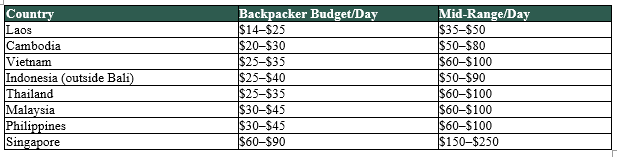
| Country | Backpacker Budget/Day | Mid-Range/Day |
These exclude international flights into the region and any visa fees. Add a 10–15% buffer on top of whatever tier you’re planning around — prices have risen 10–20% since 2023 as tourism has recovered, and no calculator predicts your spending to the exact dollar.
Country-by-Country Breakdown
Laos — The Cheapest Full Country in the Region
Laos is the number most people don’t believe until they’ve been. A backpacker budget of $14–$25/day covers a guesthouse room, three meals of local food, and songthaew rides between towns. There isn’t much nightlife infrastructure or tourist-trap pricing here yet, which is exactly why it’s this affordable — and exactly why it’s worth 5–7 days on any Southeast Asia route.
Cambodia — Cheap, With One Expensive Exception
Cambodia runs $20–$30/day backpacker, and Siem Reap in particular is a standout: $5 gets you an air-conditioned private room, and a full local meal with a draft beer runs $2–$4. The one line item that blows up your daily average is the Angkor Wat pass — $37 for one day, $62 for three days — so budget that separately rather than folding it into your “daily cost” math, or your Cambodia average will look artificially high.
Vietnam — Best Overall Value in the Region
Vietnam sits at $25–$35/day backpacker, $60–$100 mid-range, and it’s arguably the best value-for-experience ratio in Southeast Asia right now. A bowl of pho runs $1.50–$3, a bia hoi (fresh local beer) is $0.50–$1, and the country’s currency stability has kept it a relatively predictable budget compared to some neighbors. Hanoi’s Old Quarter has the highest hostel density in the country if you want to compare prices in person before booking. Set aside $120–$500+ separately if you’re doing an overnight Ha Long Bay cruise — it’s worth it, but it’s not a “daily cost,” it’s a splurge line.
Thailand — The Classic Entry Point, Still Great Value
Thailand runs $25–$35/day backpacker. Chiang Mai’s Nimman area has some of the best-value hostels in the country, with dorms averaging around $5.70/night — noticeably cheaper than the more social but pricier Khao San Road hostels in Bangkok. One thing to watch for: dual pricing at major attractions, where foreigners pay a different (higher) rate than locals. It’s built into the system, not a scam, but it does mean your “activities” line will run higher here than the food or accommodation lines suggest.
Indonesia — Cheap Outside Bali, Pricier Inside It
Indonesia as a whole runs $25–$40/day, but that number splits hard depending on whether you’re in Bali or not. Bali sit-down meals run $14–$29 — five to ten times what you’d pay for a Vietnamese street meal — and Bali also stacks on a $35 visa-on-arrival, a $10 tourist levy, and 11% VAT on top of your accommodation. Outside Bali (rice terraces, other islands), costs drop back toward the regional average.
### Malaysia — The Underrated Middle Option
Malaysia runs $30–$45/day backpacker, $60–$100 mid-range — 20–30% pricier than Vietnam on hotels specifically, but it buys you something different: a diverse, English-speaking country where Malay, Chinese, and Indian food traditions sit side by side, plus a genuinely wide range of experiences in one country, from Kuala Lumpur’s urban energy to the cool air of the Cameron Highlands to the Perhentian Islands’ beaches.
Philippines — Similar to Thailand, More Island-Hopping Costs
The Philippines lands close to Thailand at $30–$45/day backpacker. The main budget variable here is domestic flights or ferries between islands — if your route involves hopping between 3–4 islands, budget that transport separately, since it can add up faster than the daily “on the ground” costs suggest.
Singapore — Budget for a Splurge, Not a Daily Rate
Singapore runs $60–$90/day even on a tight budget, and $150–$250+ mid-range — three to five times Vietnam’s cost across every category. If your route includes Singapore, the honest move is to treat it as a 1–3 day splurge stop bookended by cheaper countries, not a place to apply your regional daily average. Even sticking to hostels, hawker centers, and the MRT, expect Singapore to eat 20–30% of a 4-week regional budget in just those few days.
What a Real 2-Week Trip Costs
Putting it together: a 2-week Southeast Asia trip runs roughly **$700–$1,200** for backpackers, **$1,800–$3,500** mid-range, land costs only — no international flights.
Two weeks is enough time to do two or three countries properly. A common, high-value combination is Thailand + Vietnam, or Bali + Malaysia + Singapore (with Singapore treated as the short splurge leg above). Trying to cram five countries into 14 days sounds efficient on paper but usually means you spend close to half the trip in transit — buses, border crossings, waiting for the next flight — rather than actually being anywhere.
Three Ways to Stretch Your Budget Further
Book accommodation through local platforms, not just international aggregators. In Vietnam, for example, booking through local platforms instead of international ones can save 15–25% on the same room.
Separate “daily cost” from “splurge” line items. Angkor Wat’s pass, a Ha Long Bay cruise, Bali’s tourist levies — none of these are daily costs, and folding them into your average will make budgeting for the rest of the trip harder, not easier. Track them as one-off expenses against a separate “big experiences” fund.
Let currency stability guide tie-breaker decisions. When two countries land in a similar price range on paper, the one with the more stable currency and lower inflation tends to hold its published prices better by the time you actually arrive — worth factoring in if you’re booking months ahead.
The Bottom Line
Southeast Asia’s reputation as the best-value region for solo travelers still holds in 2026 — $25–$40 a day gets you real comfort in most of these countries, not just survival-mode backpacking. The trick isn’t finding the cheapest possible number; it’s knowing which costs are daily and which are one-off, so your budget doesn’t quietly blow up on day nine because nobody told you about the Angkor pass.
Pick two or three countries, build in your buffer, separate your splurges — and you’ll land close to whatever number you planned for, not double it.